The post Another Set of Yoga & Pilates Classes Begin @ The Define Me Virtual Studio appeared first on Define Me Wellness.
]]>Featured this month are the Pilates Restore, Simply Restorative and Lunch Yoga-Pilates Flow series. So read on to find out more. And more to come as the summer unfolds. So stay tuned!
Pilates Restore Series

If you’re looking for the best of both worlds in a movement class – building functional core strength AND making time for mind-body relaxation – this is THE class to take! Join Tara for this combo class of Pilates and Restorative Yoga.
Pilates strengthens your integral core at the deepest layers. It aims to realign the spine while also engaging smaller “twitch” muscles. In turn, this allows your body to move as a whole – optimally and with joy. Each class will conclude with a small restorative yoga practice to allow you to connect with your mind and body and leave class feeling content and at ease.
Dates: Wednesday June 9th to July 14th
Time : 5-6:00pm
Cost: $72 for the full 6 weeks
Email Tara to register
Simply Restorative Series

Restorative Yoga is a favourite of ours, to teach and to practice as it facilitates activation of the Parasympathetic Nervous System. Above all, engaging this system is often considered the antidote to dealing with stress. Further, by focusing on slow, gentle, and subtle practices, Restorative Yoga signals to the body-mind it is time for rest and recovery. Check out what happened for this team of social workers when they began incorporating Restorative Yoga into their self-care plans.
More specifically, you will learn some relaxing breathing techniques and move through a series of fully supportive postures. Certainly, removing muscular tension within the body and peeling away any layers of stress and tension is the main goal!
Date: Monday, June 14th to July 19th
Time: 9:30-10:30am
Cost: $72 for the full 6 weeks
Email Tara to register
Lunch Yoga-Pilates Flow
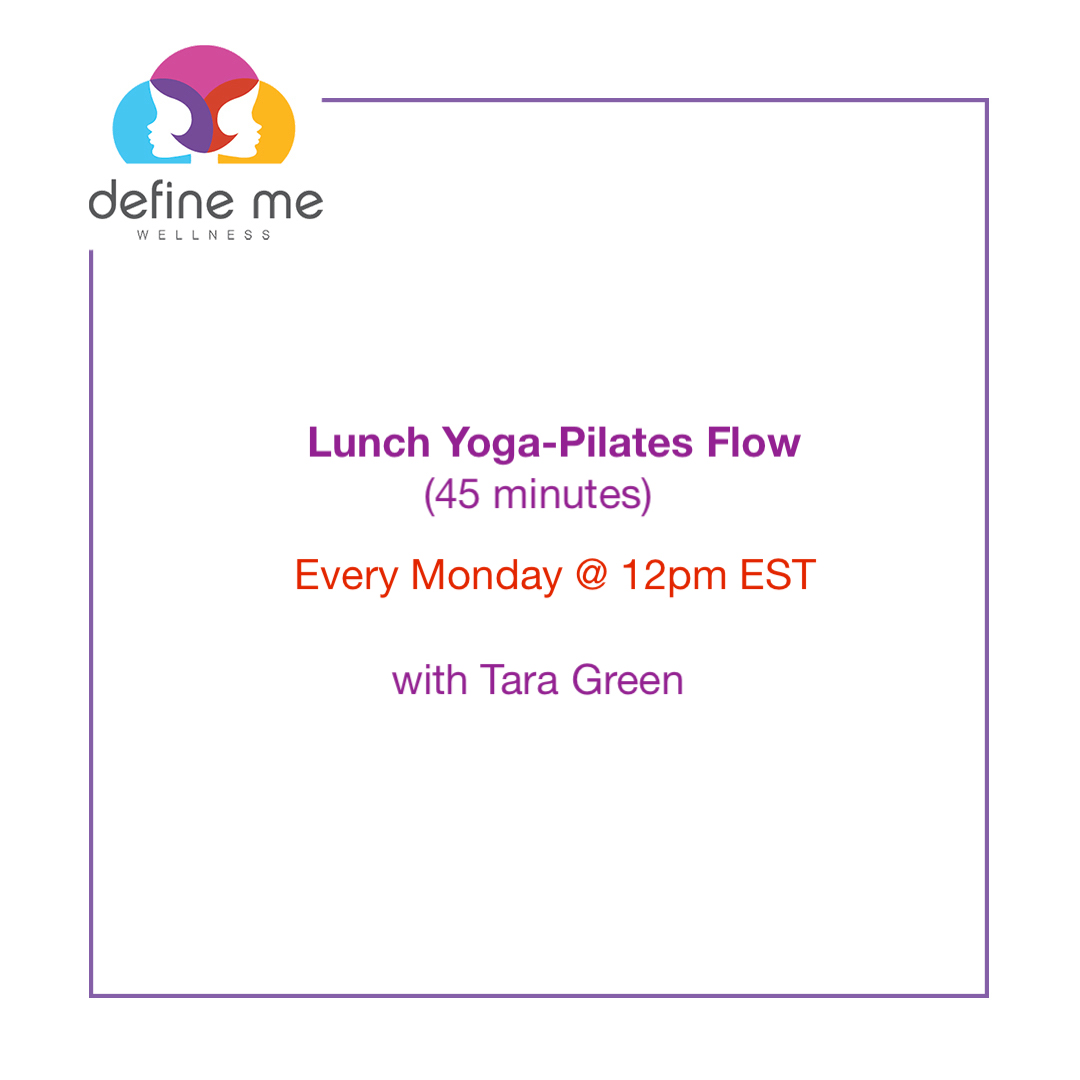
This class provides a blend of functional Pilates and Vinyasa (flow) yoga to break up your Monday. With efficiency and creativity in mind, Tara designs her classes to help you get the most out of this 45-minute class. In this way, Tara aims to make yoga and Pilates not just accessible to all bodies, but enjoyable too!
Date: Monday, June 14th to July 19th
Time: 12:00-12:45pm
Cost: $72 for the full 6 weeks
Email Tara to register
The post Another Set of Yoga & Pilates Classes Begin @ The Define Me Virtual Studio appeared first on Define Me Wellness.
]]>The post Simply Restorative Series Returns January 2021 appeared first on Define Me Wellness.
]]>
Restorative Yoga is a fantastic tool to move you into the Parasympathetic Nervous System response. Above all, engaging this system is often considered the antidote to dealing with stress. And, by focusing on slow, gentle, and subtle practices, Restorative Yoga signals to the body-mind it is time for rest. Subsequently, it provides the opportunity for a complete reset.
More specifically, you will learn some relaxing breathing techniques and move through a series of fully supportive postures. Certainly, removing muscular tension within the body and peeling away any layers of stress and tension is the main goal!
Simple Restorative 6-week Series Details:
Start date: Monday, January 18th, 2021
End date: Monday, February 22nd, 2021
Time: 9:30-10:30am
Cost: $72 for the full 6 weeks
Hosted through Zoom, participants will have access to the recording for 48 hours after each class.
In order to get the most out of your practice, we suggest that you have the following supportive props to help:
- 1 -2 pillows or bolsters if you have them
- 2 blocks or a few stacks of books
- 1 strap or a belt
- 2 blankets
- 1 chair
- Optional eye pillow
To register, email Tara at: [email protected]
The post Simply Restorative Series Returns January 2021 appeared first on Define Me Wellness.
]]>The post *New Class Alert* Pilates-Restore Coming January 2021 appeared first on Define Me Wellness.
]]>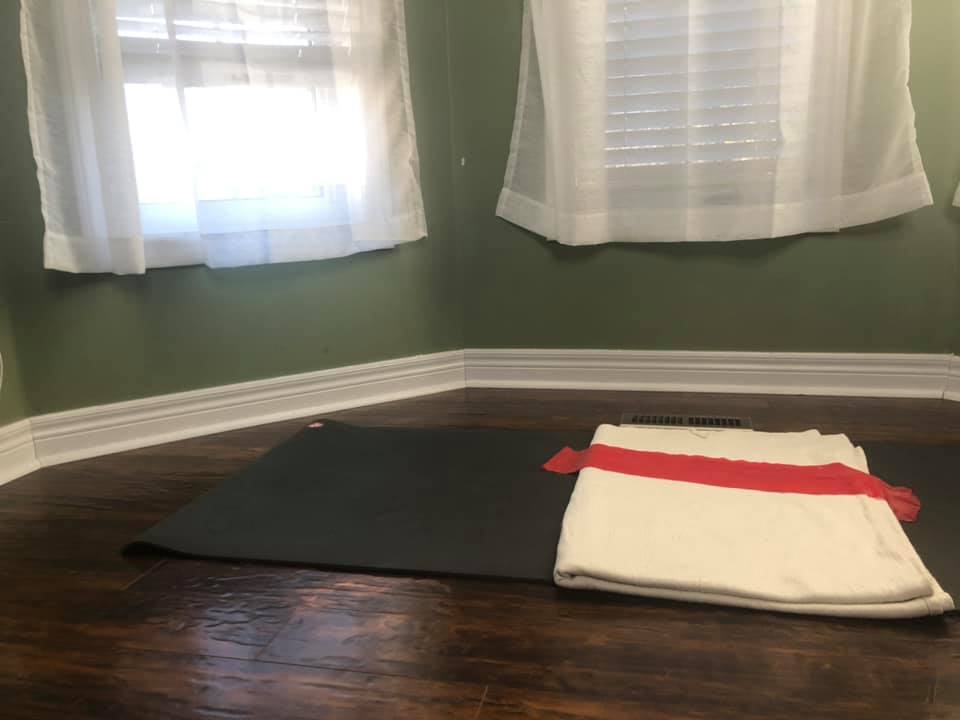
Join Tara Green for a combination class of Pilates and Restorative Yoga.
Pilates is a fantastic way to strengthen your integral core at the deepest layer. It aims to realign the spine while also engaging smaller “twitch” muscles that allow the body as a whole to move optimally and with joy.
We will end our class with a small restorative yoga practice to allow us to connect with our mind and body and leave class feeling content and at ease.
Tara has over 15 years of teaching experience and has a knack for making movement instruction relatable and fun.
6 week series details
Start date : Wednesday January 13th
End date : Wednesday February 17th
Time : 5-6:00pm
Cost : $72 for the full 6 weeks
Email Tara to register
[email protected]
The post *New Class Alert* Pilates-Restore Coming January 2021 appeared first on Define Me Wellness.
]]>The post Chronic Pain & Stress: A Gateway to Embodied Living appeared first on Define Me Wellness.
]]> I recently got a night guard to help me refrain from clenching my teeth while sleeping. Chronic jaw, neck, and shoulder pain had not been helped by some of the other interventions I tried. So the night guard was the next logical step. Four weeks into wearing it religiously every night I had gained some relief. However, the jaw pain was still there.
Fast forward to four weeks later… I’m back at the dentist’s office for a routine check up and cleaning. “The night guard has helped, I’m not experiencing as much pain as before, but still there is jaw pain”, I tell my dental hygienist as I lie back in the chair. She proceeds to tell me I might be clenching during the day too! Apparently it is really common in today’s desk dwelling culture, along with global feelings of stress, uncertainty, and productivity pressures, to be constantly contracting the jaw muscles and clenching the teeth. So much so that people are now wearing corrective mouth gear almost 24-7 to help remedy the problem.
In between her cleaning my mouth, I chuckled, “That’s kinda comical.” Instead of questioning and trying to address the root-source of the problem (i.e.: stress), we slap a band-aid (in this case, a mouth guard) on it. We look towards quick and immediate external fixes to cure longstanding and internal (personal) challenges.
About stress resilience
So that visit with my dental hygienist really got me thinking. Resilience, as defined by Merriam-Webster, is:
“an ability to recover from or adjust easily to misfortune or change”
It brought me back to this TED Talk by Kelly McGonigal. Basically, she proposes that we need to change our relationship to stress instead of stressing about how to rid ourselves of it. Because removing stress completely from our lives is an impossible task. Subsequently, since viewing that talk a few years ago, I’ve changed my language regarding this topic from a theme of stress management to stress resilience.
But Michelle, you ask, what does this have to do with mouth guards and jaw pain? Well, maybe if we changed our relationship to stress, the jaw wouldn’t need a piece of molded acrylic to handle the weight of our anxieties and overwhelm all the time, day-and-night. Perhaps, if we:
- Become more aware of our stressors
- Meet them head on (with compassion)
- To understand how we usually react (physical, emotional or otherwise) to those stressors
Then, we might find new ways to effectively be with stress. In this way, the stress could be an opportunity to become more resilient.
An Embodied Response
When I reflected back on what could have been the stress that showed up for me as musculoskeletal pain, I realized it was felt pretty soon after I started back to school, after a 20+ year “hiatus” (more on that here). Clenching my teeth and contracting my fascial muscles was my embodied response to the many worries (and realities) of a major life change. Making that connection now has me considering the ways I can adapt to the challenges of being a mature student.
First, I’ve acknowledged that, although I made a good (for me) choice to become a student again, it’s natural for me to be stressed. Stress is inevitable, in this circumstance and in life. The question is:
How am I going to respond so that the stress does not take over?
 Bodies are amazing in so many ways. They have the ability to take on all kinds of stress and to bounce back from adversity. Also fascinating is that our bodies tell us when enough is enough. I’m choosing to heed the call of what my body needs:
- Do I need more rest?
- Does the jaw need some gentle movement, restorative yoga or self-massage?
- Do I need to do more conscious and relaxing breathing?
- Does my body need to move more vigorously (i.e.: running or swimming) so as to move the tension out?
I’m still using the mouth guard at night. My body still needs that support, which is totally ok. But I’d prefer not to wear a mouth guard during the day too! Instead, I want to:
- Practice being more connected to my body’s experience of stress
- Kindly acknowledge that stress is part of life but I don’t have to succumb to it completely
- Continue to use my movement practices as a tool for self-care and bouncing back from stressful moments
Any kind of physical pain is a signal to listen, instead of ignoring the pain altogether or putting a proverbial band-aid on it. Stress might be a way for us to build awareness, find strength and practice self-care.
The post Chronic Pain & Stress: A Gateway to Embodied Living appeared first on Define Me Wellness.
]]>The post It’s That Time of Year Again! appeared first on Define Me Wellness.
]]>
I know what you’re thinking… OMG, we’ve barely gotten through Halloween yet! But every year, without fail, the hustle and bustle of December sneaks up on us. And what is the first thing to go as we get preppin’ for the festivities? Self-care! You know that it’s true. We’ve all experienced it. So, now seems like a good time to get an action plan together to pre-empt overwhelm and self-neglect.
Give yourself the gift of SELF CARE
Be specific in the self-care plan you prescribe for yourself by determining what, how often and when you will do something that is entirely devoted to you.
- What things do you currently do to practice self care?
- What might you add, revise or eliminate to optimize your well-being?
- How frequently do you take time out for yourself? Is it enough? Do you need more “me time”?
Review and revise your schedule to find the time for you. That might mean saying no, or not now, to other people’s requests and any self-assigned tasks that have been standing in the way. If you are not doing anything (or not enough) for yourself, you need to schedule it in like you would any other important appointment and stick with it – no matter what!
Try making this plan not just for the December rush. Self-care should be a daily ritual. And it doesn’t have to be any longer than 2 – 3 minutes to make a difference. Sometimes, the simplest way to do this is to take time out to breathe.
Furthermore, reassess your self-care plan monthly (or at least quarterly) to be sure it’s working for you. In that way, it will help keep it top of mind and move you to making it a regular habit.
Need Help?
On that note, if you need some guidance implementing self-care and/or movement into your lifestyle, I’m offering a 4-week wellness coaching package at a fraction of the usual cost.  For $199, we’ll work together one-on-one where you will:
- Learn practical wellness tips that are easy to apply to your day-to-day life
- Develop new lifestyle practices that help you tune into your body’s natural needs for nourishment and movement
- Reshape your well-being in a way that works for you
Includes:
- Initial consult, complimentary
- 4 – weekly private PT or yoga sessions in the home
- 4 – weekly one-on-one coaching calls
- Program cards with detailed exercise instructions
- Unlimited email support
- And MORE
- Valued at over $500
This Holiday promo only comes around once a year and there are just a handful of spots available. Contact Michelle today to see if the Define Me Way is right for you.
The post It’s That Time of Year Again! appeared first on Define Me Wellness.
]]>The post The Body Acceptance Series Part III: Putting Theory Into Practice appeared first on Define Me Wellness.
]]>Over the last few blogs, I’ve introduced you to some concepts for eating disorder recovery and healing. These practices stem from:
- My personal experience
- The way I engage with clients
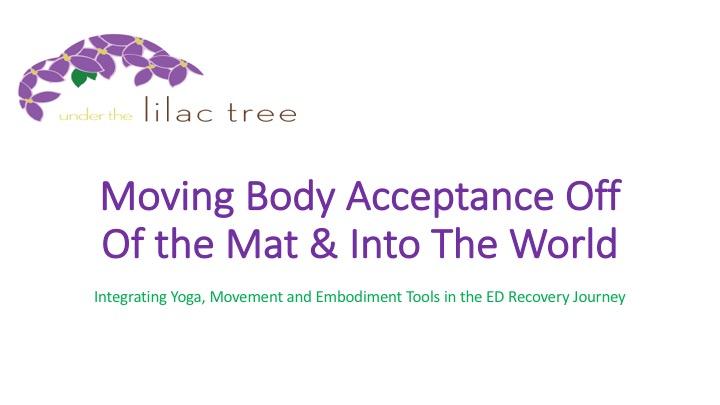
- And the presentation I gave this past May at the NEDIC conference: Moving Body Acceptance Off of the Mat and Into the World
 In Part I of this series, we talked about creating a space of safety for healing. And in Part II, we cultivated a heartfelt intention to keep us rooted in our journey. Finally, here in Part III, I will take you through a guided relaxation where we’ll combine all learnings from this 3-part Body Acceptance series.
Can Stillness Bring Change?
I firmly believe so. Prior to discovering the practice of Restorative Yoga and Yoga Nidra, I used to believe change came from constantly moving > striving > doing stuff. Even in my ED recovery I felt I needed to check off the “tick boxes” of the supposed steps in recovery. But now, I realize personal growth and change is not so linear. And lying dormant isn’t necessarily a bad thing. Sometimes the most profound changes come from being still and getting in touch with the deepest part of ourselves – very slowly and thoughtfully.
Enter: The Practice
“There is a part of you that is whole, healthy and not needing to be fixed.”
~ Richard Miller, psychologist and founder of iRest
I believe becoming more accepting of your body means practicing it, regularly. And I don’t want you to waste one more minute in theory! So I’m going to leave this 30-minute guided relaxation right here for you to explore, on your own time, in your own healing space.
Let us know how it goes! <3
The post The Body Acceptance Series Part III: Putting Theory Into Practice appeared first on Define Me Wellness.
]]>The post The Body Acceptance Series Part II: The WIIFM of Healing & Recovery appeared first on Define Me Wellness.
]]>WIIFM stands for “What’s In It For Me”. And it’s most notably referenced in the marketing and selling of a product or service. But in Part II of this Body Acceptance series (click here for Part I), I’m borrowing the WIIFM phrase to explore the deep-seeded reasons why someone seeks healing and recovery. I’m particularly drawing on my presentation last month at the NEDIC conference “Moving Body Acceptance Off Of The Mat & Into The World”.
WIIFM is a marketing approach to highlight the key selling features that will attract consumers to buy what a business is selling. It drives the promotion strategies used. And, if done well, continually focusing on the consumer benefits when advertising brings higher sales.
However, the “buying and selling” of eating disorder treatment is not easily strategized or packaged. Healing and recovery on this front is deeply personal, with umpteenth reasons for seeking it out. There is no cookie cutter approach. But, getting a clear understanding of the reasons why you are starting on the ED recovery path can:
- Help articulate your recovery goals and intentions going forward
- Be an anchor to what keeps you going, especially when the changes you’re making feel difficult
What am I longing for?
Selling anybody, on anything, is not the way I operate. The resolve to heal has to come personally from within. And no amount of persuasion or marketing tactics is going to sell you on the need/desire for healing.
Instead, when clients start working with us, the suggestion is that they ask themselves why they are here in this stage of their recovery journey. In other words, WIIFM is reframed with questions like these:
- Where does the eating disorder make life difficult/challenging?
- What are some negative feelings/experiences that the eating disorder creates?
- How are these behaviours not serving me at this time?
- When the eating disorder is no longer a guiding force in my life, what does that look like?
- Or… what am I longing for?
When participants and I pondered these questions at the NEDIC conference, there was a general consensus that life with an ED is anxiety-provoking, nerve-wrecking, surrounded by so much fear and a feeling of being overpowered by the ED thoughts/behaviours. But, on the other side of that, might be freedom, personal trust and inner peace. And remembering the personal intention (the longing) at the forefront of the recovery process, is one way to solidify one’s commitment to healing.
From “May I….” to “I am”
Practices such as meditation, reflection and journaling can be effective tools for disrupting the ED. Loving Kindness Meditation (LKM) is one type of attention that can guide us from a place of self-loathing to self-compassion. A LKM has the following recited phrases: “May I be safe; may I be healthy, may I be happy and may I live with ease.” Therefore, it is a hope for healing, recovery, change.
However, if we tap into our heart’s deepest desire and use the yogic practice of Sankalpa, change becomes more imminent.
Sankalpa is Sanskrit for heartfelt intention, a solemn vow, your heart’s deepest desire. It typically has the following characteristics:
- A personal commitment
- Affirming, positive
- Rooted in the present tense
In other words, your heartfelt intention is an anchor for where the recovery process will ultimately take you – realizing your true purpose in life.
Developing your Sankalpa (Heartfelt Intention)
- Have a pen and paper handy
- Find a quiet place for reflection
- Go back to the questions above in the What am I longing for? section.
- Pay particular attention to what it is your heart is longing for
- Keep your statement brief, something you can easily recall and recite to yourself often
- Write it down
- Close your eyes and repeat your Sankalpa to yourself several times
- Sit for a while and feel how this statement shows up in the body
Crafting your Heartfelt Intention can take some time. Also, it doesn’t have to be perfect. But if you’re struggling to find one that works for you, here are a few examples to get you started:
- I am…
- I welcome all impressions as interesting notes of discovery
- I trust myself
Up next: Michelle will guide you through a Yoga Nidra practice. Stay tuned for this 20 – 30 minute guided relaxation, where we’ll combine all learnings from this 3-part Body Acceptance series.
The post The Body Acceptance Series Part II: The WIIFM of Healing & Recovery appeared first on Define Me Wellness.
]]>The post The Body Acceptance Series Part I: Creating the Space for Body Acceptance appeared first on Define Me Wellness.
]]>May 11th, 2017 was a career highlight for me as I presented on this topic (image above) at the Body Image & Self Esteem Conference for the National Eating Disorder Information Centre! Such an important and thrilling (a little nerve-wrecking) task to take on but it was an opportunity I could not pass up.
The original presenter was unable to present on “Moving Body Acceptance Off Of The Mat And Into The World” so I was asked to facilitate it instead. A lofty goal, I think, to address all that is in that title, in only 75min. And so many directions the presentation could have taken! But I chose to:
- Draw on my lived experience
- Leverage my understanding on the concepts of neuroscience and embodiment
- And weave throughout some of my favourite embodiment tools (and there are many) in an effort to encourage self-discovery, healing and change
This 3-part series is to share that presentation (and possibly more) here, with you! I hope it will intrigue and inspire colleagues, clients/patients, caregivers and those in recovery in the complex field of Eating Disorders (EDs).
Let’s Explore, Question and Discover
In this 3-part series we will address, what I believe, are helpful components for recovery and healing:
- Designing a “mat” space as a personal labratory
- Asking the ultimate question: “What is it I and/or my client are longing for?
- Testing various tools/practices for engaging with the body in an embodied way
So let’s explore the first component that can be a starting off point in the journey…
Our “mat space” as our personal laboratory
EDs and body image disturbances are ailments that promote disconnection from the natural, integrated wisdom between the mind and body. In recovery, we are attempting to repair that separation. And yet connecting to the body experience again can be very scary. 
Neuroception: a term coined by Dr.Stephen Porges, describes neuroception as a wiring within our nervous system, interpreting the environments we’re in as places of safety or potential threat
If the intention is to gradually cultivate a sense of acceptance and connection for our bodies, then we need to feel safe to explore the body experience in a neutral way (I wrote more on body neutrality in this post).
One of the ways to create safety in ED recovery, is to begin with establishing boundaries for those explorations. The yoga mat can be a physical manifestation of that needed safe place. It can be a place to practice new concepts. And when we are on our mat space it is:
- A judgment-free zone, where you don’t have to “be” or “do” anything
- And you approach the body and your noticed responses with sincere curiosity. I like to use the phrase “Hmm, isn’t that interesting!” whenever something comes up for me
A Ceremony: Creating Your Mat Space
In my NEDIC presentation, participants didn’t have an actual mat. And you don’t need one either. But you can map your “mat space” as your personal laboratory wherever you feel is best to do so:
- A good place to create that space might be your bedroom
- Stand in whichever space you choose
- If you have a mat, roll it out in your chosen space. Or visualize a mat, in whatever shape and size feels necessary
- Close your eyes, with arms spread out wide, take up space. Pause
- Declare to yourself “This is my sanctuary. This is my anchor. This is my safe place”
- Consider slowly and deliberately doing a 360 degree turn of your mat space
- With arms stretched out as you turn, continue to repeat the above declaration
- Once your mat space feels firmly designed for your personal explorations and comfort, complete the ceremony
Coming Soon: Part II of this Body Acceptance series will explore the question: What is it that I and/or my client are longing for? Until then, return to this safely (mat practice), slowly, gently and repeatedly
The post The Body Acceptance Series Part I: Creating the Space for Body Acceptance appeared first on Define Me Wellness.
]]>The post Neutralizing the Body Experience: From self-love to body hatred and everything in between appeared first on Define Me Wellness.
]]>
Over the last several years, there’s been a lot of talk about loving yourself in the body-positive movement. And while that’s a wonderful notion, loving ourselves when we’re at war with our body can feel like an impossible task. Or, maybe it just feels pointless in that we’re setting ourselves up for failure, disappointment. Furthermore, when we’re experiencing the following things:
- Chronic pain
- Chronic illness
- Trauma, or
- Stigma for a body that does not fit the cultural ideal…
The act of self-love can seem unfathomable. In other words:
Self-love in trying times can feel like a bunch of BS!
Awhile back I was on the “you gotta practice self-love” train too. That was until my train got derailed. Well, I’ve learned the hard way that chronic pain and illness can be physically/emotionally/spiritually painful. I hated my body way more than I loved it. That is for sure!
 What does it mean to “neutralize the body experience?
However, I also now realize that body hatred is a form of body combat. And that kind of in-fighting only wires us for more stress. Which then only serves to keep or amplify dis-ease and unrest in both body and mind.
So what if we could rest in a space within us that didn’t have to be loving? Or hating?
What if we could rest in a place within ourselves that witnessed the whole body experience? The mistakes? The successes? The limitations? The abilities? The good? The bad? The right? The wrong?
And what might happen if we explored all these things in a state of presence and objectivity?
Finally, is it even possible to reach neutral ground with your thoughts/feelings/beliefs about your body? Well, I think so! Herein lies one of my favourite practices – Yoga Nidra…
What is Yoga Nidra?
Yoga Nidra is a form of guided relaxation, also known as “awakened sleep” or deep conscious rest. While the body is in a relaxed and still position, participants navigate the thoughts, beliefs and emotions of the fluctuating mind.
 Yoga Nidra puts a pause on the high stress experience of living in an injured, traumatized or stigmatized body. The parasympathetic nervous system takes over to facilitate a rest and digest state.
And just by being in this rest and digest mode, we physiologically bring our bodies into a neutral zone without having to force anything else (loving, hateful or otherwise).
A Yoga Nidra practice typically includes the following 2 things:
- An intention that is affirming, action oriented and in the present tense
- Exploring both extremes of various experiences, attempting to experience them at the same time
A Yoga Nidra Practice to Neutralize the Body Experience
Wanna try? I recorded a brief Yoga Nidra practice that I’m happy to share here. Before you begin:
- Remove potential distractions
- Find a space that is quiet and where you won’t be disturbed
- Setup in a comfortable position on the floor or chair
Here is your guided Yoga Nidra Session (20 minutes):
***Curious to try more Yoga Nidra and other relaxation strategies? Check the schedule for our next round of Small Group Restorative sessions and for registration details. Or, if group settings are not your thing, Michelle is booking 1:1 private sessions also. Contact us to set up your complimentary phone consult.
The post Neutralizing the Body Experience: From self-love to body hatred and everything in between appeared first on Define Me Wellness.
]]>The post Restorative Practice to Help with Anxiety: The Swaddle, Part II appeared first on Define Me Wellness.
]]>The Art of Self-Swaddling
What do you do though, if you want to be swaddled but don’t have anyone around to help you with the setup? Well, I’ve been experimenting lately with self-swaddling and I think I’ve found a technique that works pretty well! So, here’s a 5 minute video demo-ing how to swaddle yourself:
NOTE: This does require rolling the body and that movement pattern might not be suitable and/or available to everyone. Please refrain from trying this if you are recovering from an injury or if you have joint and/or mobility issues.
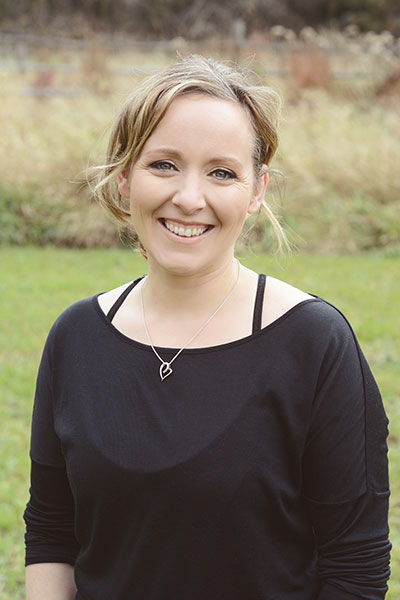
Michelle Pitman is the the founder and operator of Define Me Wellness. Michelle supports clients on their own path to well-being with specialities in healing body image, enhancing athletic performance and cultivating work-life balance. Click here to learn more about Michelle and her work.
The post Restorative Practice to Help with Anxiety: The Swaddle, Part II appeared first on Define Me Wellness.
]]>